
AI is Killing Email Lists: Build Yours to Survive
At a Glance
- Target Audience
- Microsoft 365 Marketers, Power Platform Community Builders
- Problem Solved
- Email lists losing effectiveness due to AI assistants filtering inboxes, blocking access to real customers.
- Use Case
- Future-proofing email nurturing for M365 training businesses like Collab365 against AI gatekeepers.
Russell Brunson posted something on X this week that made me stop scrolling.
"Kylie Jenner just lost 15 million Instagram followers in a few hours. I've been saying this for 20 years. Your list is your business. Everything else is rented".
The gist was simple: Meta had apparently run a big Instagram cleanup, and some very famous people suddenly lost millions of followers. Bots, inactive accounts, fake reach, numbers that looked impressive until the platform decided they did not count anymore.
Russell's point was the one he has been making for years: your list is your business, and everything else is rented.
And he is right.
Mostly.
The Comfort Blanket
Helen and I have lived this lesson inside Collab365. We have seen Google traffic change, social reach wobble, platforms shift the rules, and AI start sitting between people and the content they used to click. If we had built Collab365 only on borrowed reach, we would probably be gone.
The direct relationship matters. Email matters. Customers matter. People who know you, bought from you, trusted you, replied to you, complained to you, learned from you, and came back again. That is real.
But on our walk with Hugo, I kept coming back to one awkward question: what happens when AI sits in front of the list?
Because the old advice assumes direct access. You might not own Instagram, LinkedIn or YouTube, but if you have the email address, you can reach the person. That has been the comfort blanket. I am not sure it stays that simple.
We are heading towards a world where AI filters a lot of what reaches us. Not just spam filters as we know them now, but actual assistants: personal assistants, work assistants, procurement assistants, inbox agents, calendar agents, phone agents, customer service agents.
They will read, rank, summarise, file, answer, reject, delay, shortlist, and sometimes buy. The email may still arrive. The human may never see it.
That changes the meaning of "owning the list".
The AI Bouncer
Helen described it as a bouncer, and that is exactly how it feels. Your list gets you to the door. The agent decides if you come in.
That sounds bleak if you are a marketer, but it sounds brilliant if you are a buyer. Because, let us be honest, a lot of marketing deserves to be blocked. The fake urgency, the lazy personalisation, the "just circling back", the "quick question", the seventeen-message sequence that somehow manages to be both automated and needy. If AI protects people from that, most people will welcome it.
I probably would. Helen definitely would.
But this creates a very different problem for businesses. For years, the battle was, "How do we get into the inbox?" The next battle may be, "How do we become one of the three things the assistant thinks are worth showing?"
That is a much harder game, because AI will not care that your subject line has a curiosity gap. It will not feel guilty because you said "last chance", and it will not be impressed by a fake countdown timer. It will ask, in its own machine-ish way:
- Is this relevant?
- Is there a prior relationship?
- Has this person bought before?
- Did they get value?
- Is the timing right?
- Does this match a current need?
- Is the offer clear?
- Can the claim be trusted?
- Is the price sensible?
- Are the terms understandable?
- Does this deserve to interrupt the human?
That last question is the killer: does this deserve to interrupt the human?
Most marketing is not built to answer that. It is built to get attention. AI gatekeepers will be built to protect attention. Those two things are going to collide.
The Email Changes
And if that happens, email itself starts to change.
Provide a caption (optional)
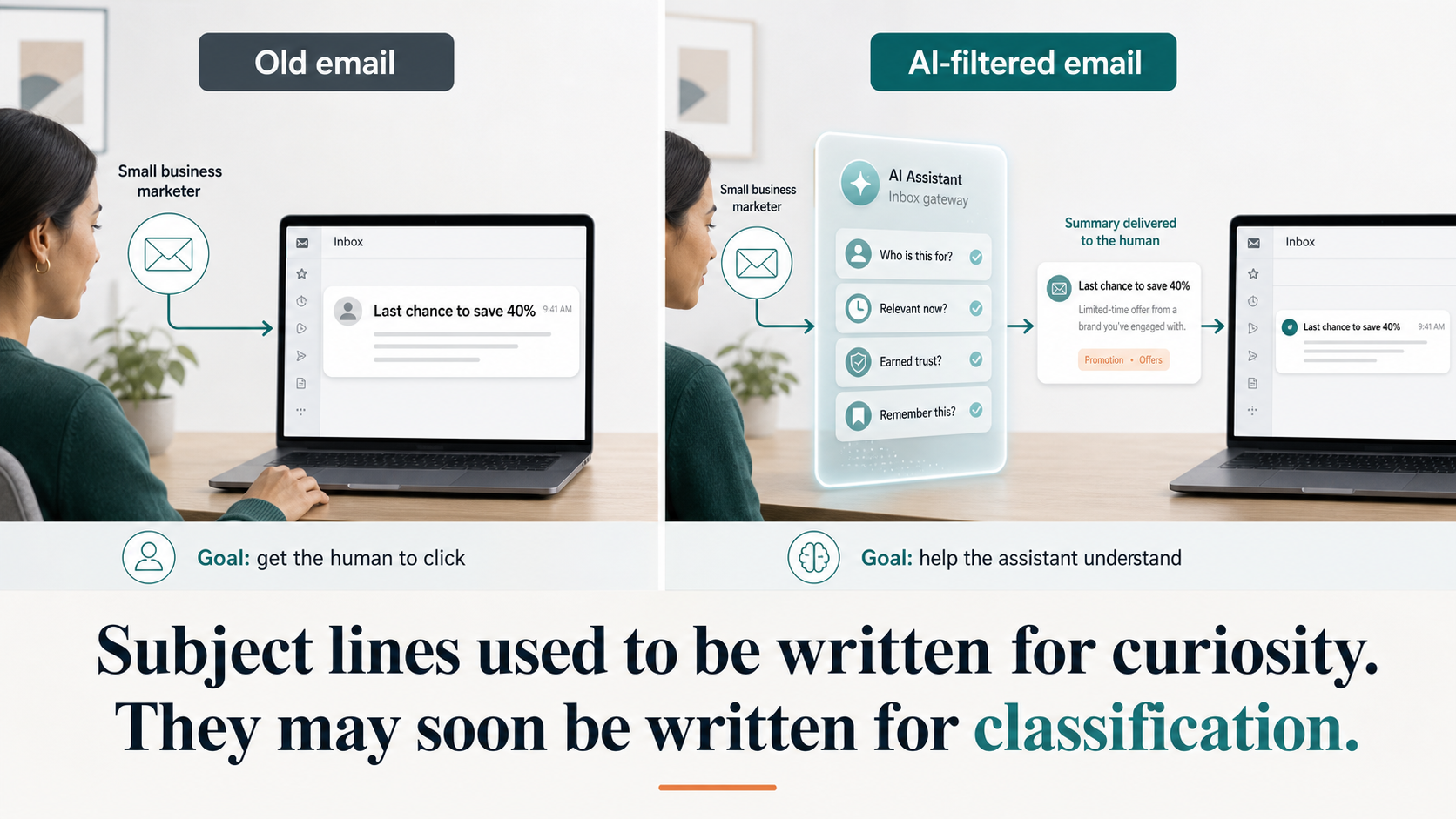
Subject lines used to be written for curiosity. They may soon be written for classification. The old job was to get the human to open. The new job may be to help the assistant understand.
That does not mean every email becomes a giant FAQ. Please no. But it may mean the email needs enough plain-English context to survive being read by software first.
- Who is this for?
- What problem does it solve?
- Why now?
- What proof exists?
- What would a sensible buyer need to know before bothering the human?
That is not longer for the sake of being longer. It is clearer for the sake of being remembered.
And that is where Helen spotted the upside. Humans forget emails almost immediately. I do. You probably do. Something useful arrives at the wrong time, we skim it, think "that might be useful later", and then it disappears into the swamp.
An AI assistant may not forget in the same way. It might remember that six months ago you mentioned a service, an offer, a case study, a pricing point, or a useful guide. Then, when the person finally has that problem, it might surface you again.
That is a strange thought. AI may make lazy email marketing less effective, but it may also make genuinely useful email marketing more durable. The email does not just have to get opened today. It may need to be understood, stored, matched, and resurfaced later.
That is a completely different discipline.
The Phone Call Changes Too
And it will not just be email. Cold calling will change too. Imagine ringing a company in a few years. The first voice you hear is not a receptionist. It is an AI agent trained to protect the team from pointless interruptions.
- Who are you?
- Why are you calling?
- Do we know you?
- Did someone ask for this?
- What problem do you solve?
- Is this relevant to a live project?
- Can you send proof?
- Can you speak to our procurement agent instead?
That sounds annoying if you are selling. It sounds sensible if you are busy.
The List Still Matters
And this is where Helen pushed back on me, quite rightly. She said the list will still matter.
She is right. I do not think email lists become worthless. I think weak lists become worthless.
A list full of people who never asked to hear from you, never bought, never engaged, never trusted you, and only exist as rows in a CRM? That is going to struggle.
But a real relationship may become more valuable, because the AI assistant may use that relationship as a trust signal.
- This person has opened your emails before.
- This company has bought from you before.
- The refunds were low.
- The support history was good.
- The content was useful.
- The offer matches their current problem.
- The sender has earned attention.
That is a very different kind of marketing asset. Not "I have 50,000 email addresses." More like:
"I have 50,000 relationships with enough context, trust and proof that an assistant can understand why we matter."
That is the shift. The list is not dead. The lazy interpretation of the list might be.
What This Means For Small Businesses
And this is where I think small businesses need to start thinking now. If AI becomes the gatekeeper, your marketing needs to be understandable to both humans and machines. That means clear offers, clean product data, honest pricing, proof of outcomes, useful content, customer history, useful FAQs, trust signals, refund policies, security information, compatibility details, and real answers to real objections.
Not because humans are going away, but because the route to the human may increasingly pass through software.
At Collab365, this is one of the reasons we keep obsessing about memory, context and usefulness. Random pages, scattered posts, vague claims and disconnected campaigns will be harder for AI to understand. Connected knowledge will matter.
- Who is this for?
- What problem does it solve?
- What evidence supports it?
- What changed?
- Why now?
- Why should this person care?
Those are not just copywriting questions anymore. They may become delivery questions, because the assistant may decide whether your message is worth delivering.
So yes, build the list. Please build the list. Do not build your business entirely on rented social reach. Russell is right about that.
But I think the next version of the advice needs another line.
Build the list. Then build enough trust, proof and relevance that an AI assistant lets you through.
Because in the next version of the internet, the inbox might not be the destination.
It might be the lobby.
And the bouncer may be code.