
WordPress powers 42% of the web. That might be the problem.
At a Glance
- Target Audience
- Power Platform Managers, Microsoft 365 Web Admins, Collab365 Operators
- Problem Solved
- Outdated WordPress editing workflows clashing with AI tools, ecosystem vulnerabilities, and migration pains blocking AI-native content management.
- Use Case
- Migrating community sites like Collab365 Academy from WordPress to AI-first platforms with structured, agent-readable content for AEO.
We are not watching this from the sidelines
Helen and I were talking about WordPress on our walk with Hugo this yesterday, which is never a sign that the day is going to be emotionally light.
We used WordPress for almost everything at Collab365: the main site, the Academy, Power Platformer, Collab365 Today, blogs, sales pages, landing pages, course areas, checkout flows.
The lot.
And now we are in the process of moving completely away from it.
That matters because WordPress is not some niche tool. According to W3Techs, WordPress currently powers about 42% of all websites. Not 42% of blogs or 42% of small business sites. About 42% of the web.
Among websites with a known CMS, it has roughly 60% market share.
There is also an entire economy sitting around it: hosting, agencies, themes, plugins, maintenance, SEO, security, training and migrations. WP Engine's WordPress Economy study estimated that ecosystem at nearly $600bn back in 2020.
So when people say "WordPress is not going anywhere", they are right.
That is exactly the point.
The opportunity is not that WordPress vanishes. The opportunity is that a huge installed base may need help crossing into whatever comes next.
This is not a mass exodus. Yet.
I do not think the evidence says everyone is suddenly leaving WordPress.
That would be too easy, and probably wrong.
The better reading is that WordPress is still dominant, but the growth story has changed.
HTTP Archive's 2025 Web Almanac says WordPress remains the clear CMS leader, but its growth has slowed to under one percentage point year over year. It describes the shift as looking more like market saturation than one rival knocking WordPress off its throne.
Search Engine Journal made a similar point using W3Techs data: WordPress was still huge in October 2025, powering 43.3% of websites and holding 60.7% CMS share, but that was down from a 65.2% CMS-share peak in 2022.
At the same time, simpler SaaS platforms like Shopify, Wix and Squarespace have been gaining ground in specific parts of the market.
So no, this is not "everybody is fleeing WordPress".
It is more subtle than that.
The default is weakening.
The automatic assumption that a business website should be WordPress is starting to feel less automatic.
This is not a WordPress-bashing post
And to be clear, WordPress helped us build a lot.
I have administered WordPress sites for more than 10 years. I have coded plugins. Helen has used it for years from the non-technical operator side, editing pages, updating content, and working inside the mess that sits behind the public site.
So this is not a "WordPress is rubbish" post. It is more awkward than that.
I think WordPress may have been brilliant for the web we had. I am not sure it is shaped for the web we are moving into.
AI made the old editing model feel absurd
The thing that pushed us over the edge was AI. Not because AI made WordPress impossible to use, but because AI made the old editing model feel absurd.
The workflow was painfully familiar: open a page in WordPress, find the right bit inside Thrive Architect, copy the text from a box, paste it into Claude or ChatGPT, ask for a rewrite, copy the new version back, paste it into the box, fix the formatting, realise another box needs changing, repeat.
Then mutter darkly.
Helen described it better:
"I never knew if I was editing content or dismantling a bomb."
That is funny because it is true.
The AI was not part of the editing experience. It sat outside it. So instead of making the site easier to run, AI added another layer of copy-paste tax.
That is one of the reasons I built Collab365 Spaces and our own blog to be AI-first, and why we are gradually pulling the business away from WordPress altogether.
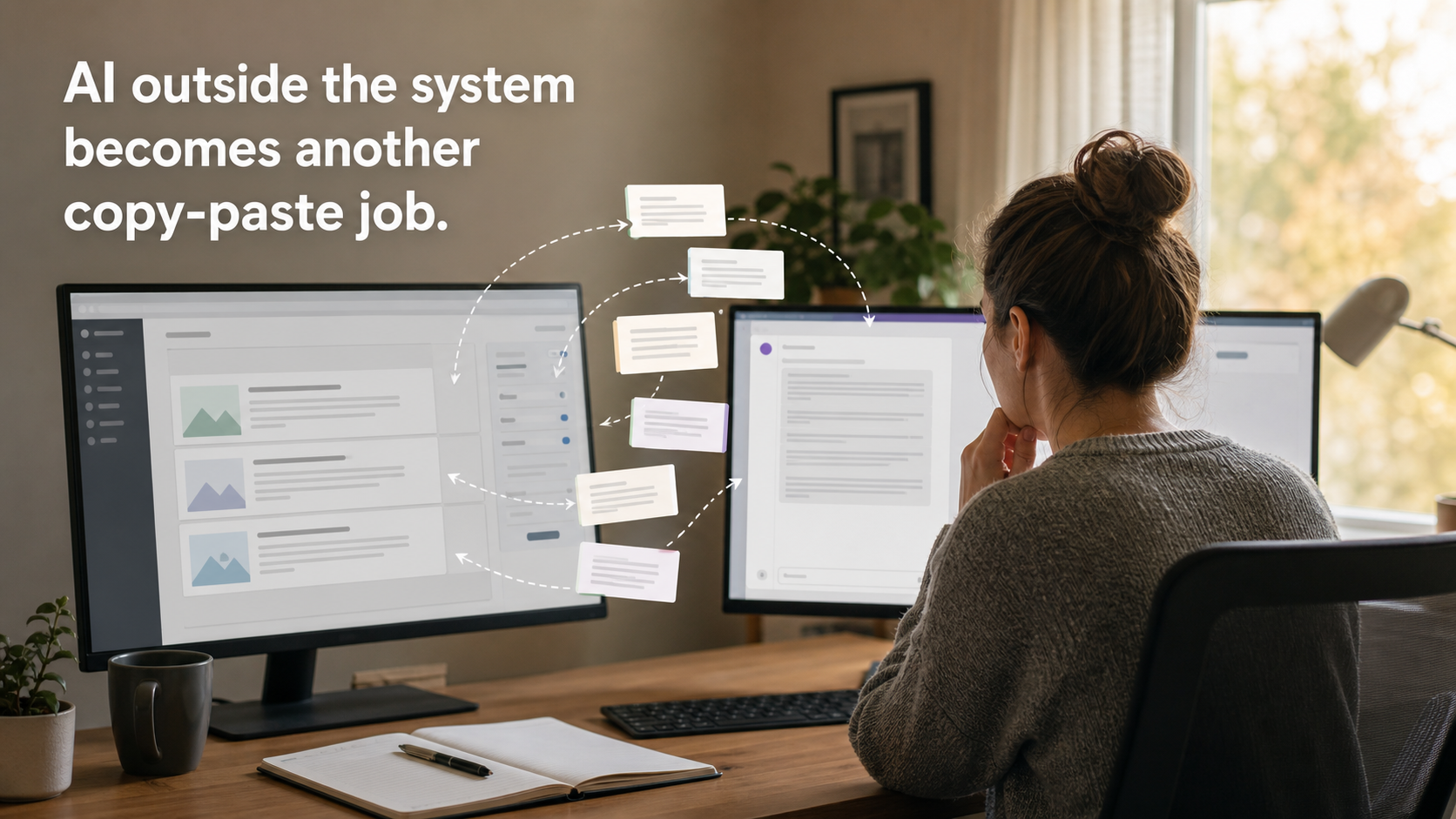
I wanted the site to help us run the site. Not in a vague "AI-powered" way, but in a practical way.
The system should know the content, context, the audience, the offer and the tone. It should know what article links to what course, what topic belongs to what space, what needs updating, what can be repurposed, and what should not be touched.
You should be able to say:
"Rewrite this for our audience, create two LinkedIn wrappers, update the call to action, generate an image, use this skill, and tell me if anything is out of date."
And the system should be able to help inside the system.
Not by making you copy chunks of content into a chatbot and paste them back into little boxes like it is 2011 with better autocomplete.
That is the old editing model, and I think the old editing model loses.
AI features are coming. That is not the same as an AI-first architecture
To be fair to WordPress, it is not ignoring this.
WordPress announced a dedicated AI Team in 2025. There is already an official AI plugin, and the AI Building Blocks work includes sensible pieces like an AI Client SDK, an Abilities API and an MCP Adapter so assistants can discover and call WordPress capabilities.
That is the right direction.
But it also proves the size of the problem.
Adding AI features to WordPress is one thing. Bringing the whole installed base, plugin ecosystem, page-builder universe and long tail of old business logic along for the ride is something else entirely.
The awkward question is not, "Can WordPress add AI?"
Of course it can.
The awkward question is:
Can WordPress become AI-native without breaking the enormous ecosystem that made it dominant?
The moat may also be the weight
The bigger question is whether WordPress can become truly AI-first while still powering so much of the existing web.
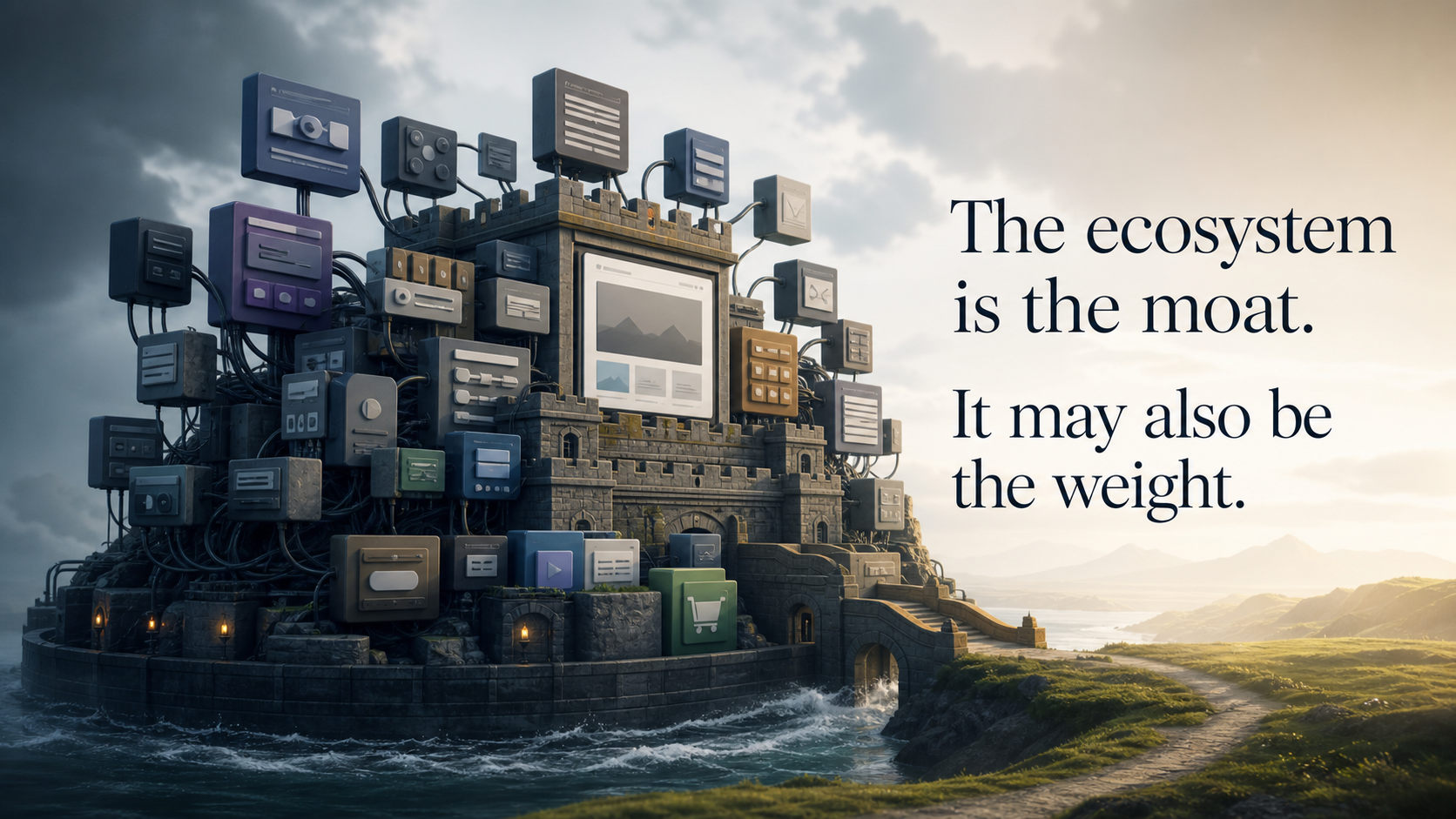
That is a brutal problem, because WordPress did not become massive by being simple. It became massive because of its ecosystem: themes, plugins, page builders, commerce, membership, learning, SEO, forms, analytics, communities and custom fields.
That ecosystem is the moat. But it may also be the weight.
This is the part I think people underestimate.
WordPress does not just need a smarter editor, a chatbot in the sidebar, or a few clever AI actions in wp-admin.
To survive the next version of the web, it may need to become a system where content is structured, connected, queryable, agent-readable (read up on AEO) and safe to update automatically.
That is a very different job from publishing pages.
And the harder problem is that WordPress has to do that while supporting millions of old sites, old themes, old plugins, old page builders, old checkout flows, old membership systems and old bits of business logic that nobody fully understands anymore.
That plugin problem is not theoretical either. WordPress.org currently says there are over 63,000 free plugins in the directory. Patchstack's 2025 vulnerability statistics show plugins accounting for 91% of recorded WordPress ecosystem vulnerabilities, with 45% of published vulnerabilities listed as not patched.
Patchstack also reported that 1,614 plugins and themes were removed from the WordPress repository in 2024 because of unpatched security issues.
That does not mean WordPress is uniquely bad. It means ecosystems age.
Some plugins will modernise. Some will be acquired. Some will become security risks. Some will quietly stop being maintained. Some will never become clean, agent-readable building blocks.
That is why 42% of the web might be the problem.
The scale that made WordPress dominant also makes reinvention brutally hard.
- Every plugin stores data differently.
- Every page builder renders things differently.
- Every membership setup has its own logic.
- Every old site has shortcodes, redirects, custom fields, image folders, checkout flows, course rules, user data, SEO baggage, and some mystery setting nobody remembers touching in 2018.
We know because we are doing this ourselves. We are not theorising about a migration away from WordPress; we are in the middle of one.
And it is painful. Not "small inconvenience" painful. Properly expensive in time, attention, and brain.
If it is painful for us, with my technical background and Helen's years of actually using the system, what does that mean for normal site owners?
The next website may not be a website
That is where I think the opportunity sits.
I do not know exactly what wins yet. Maybe WordPress manages to reinvent itself. Maybe a new AI-first CMS appears. Maybe Cloudflare or another platform creates the new base layer. Maybe more people simply vibe-code their sites and connect them to their own data.
Maybe the whole idea of a website changes more than we expect.
Because there is another uncomfortable question sitting underneath all of this:
What is a website for when humans stop being the main visitors?
For years, the model was obvious. Humans searched Google, clicked links, read pages, saw ads, joined newsletters and bought things.
But what happens when AI agents become the things reading on our behalf?
What happens when Google sends fewer clicks like we're already seeing on our websites?
What happens when AI systems summarise your work without sending the visitor?
What happens when the site is less of a brochure and more of a knowledge/API layer for agents, customers, products, and workflows?
That is not the web WordPress was originally built for.
WordPress won the human web. But the next web may not be human-first.
And if that is true, millions of site owners are going to face a horrible choice.
They can stay on an old architecture that was built for pages, plugins and human editors. Or they can migrate into something AI-first, agent-readable, and much more connected.
Neither option is easy. Migration is expensive. Staying put may become expensive too.
The opportunity is the migration
That is why I keep coming back to the business opportunity.
If even a small percentage of the WordPress world starts asking, "What should our site become now?", that is not a tiny market.
That is migration work, strategy work, content restructuring, data cleanup, agent-readable knowledge layers, new CMS patterns, new hosting models, new agencies, and new tools for turning old pages into systems that can be read, queried, updated and acted on.
In other words, the next opportunity may not be "build websites".
It may be:
Help people move from websites to living business systems.

So no, I do not think WordPress disappears tomorrow.
There is too much of it. Too many businesses depend on it. Too many agencies, plugins, workflows, and sites sit on top of it.
But long term?
I think WordPress has a much harder problem than people admit.
It does not just need AI features. It needs to answer a bigger question:
Can a system built for the old web become the operating layer for the next one?
I am not sure. And that uncertainty feels like a very big business opportunity.